Correct Pronunciation of Bengali alphabets: বাংলা বর্ণমালার নির্ভুল উচ্চারণ: Read the article⇗
The next version is coming soon.⇗
Rabindra Sangeet Albums. Sung by the verified singers of this website. 160 talented singers & over 850 songs.
Rabindra Sangeet Collections. Sung by the verified singers of this website. Nearly 500 unique Tagore songs.
Detail information about Rabindra Sangeet. All the lyrics, notations, background history with detail musical compositions, English translation and many more.
Lyric and background history of song thamao rimiki jhimiki
Song of Rabindranath Tagore
This page contains lyric of Tagore song thamao rimiki jhimiki and its transliteration in English with background history. Background of the song includes the place and date of the song written by Rabindranath, name of the newspaper or magazine the song was first published in and the name of the person who had prepared the notation or swaralipi. This page also contains the musical composition of song like parjaay, taal, raag and ango.
The other related elements of this song like translation in English and Hindi, notation in Bengali (swaralipi), staff notation (western) which are available in other pages, please find the related links below. We have also provided the pdf's of lyric, notation and staff notation with midi with downloadable links so that people may find it easier to get the song and notations in printed format.
Musical composition and background history of the song:
Parjaay: Prakriti (109)
Upa-parjaay: Borsha (84)
Taal: Kaharwa
Raag: Hameer-Kedara
Written on: 1937
Published in: Probasi
Swarabitan: 58
Notation by: Shailajaranjan Majumdar
Notes: This song was first published in autumn, 1937.
Shantidev Ghosh, in his book 'Rabindra-sangeet', has written –
... 'Barsha-mangal', directed by Gurudev had been staged for the last time in Kolkata in 1937. A number of songs for the monsoon had been composed for the purpose at Shantiniketan. The program at Shantiniketan was a grand success and people had requested Gurudev to organise a similar program at Kolkata. Gurudev had agreed to the proposal and asked the artists at Shantiniketan to continue with the rehearsal while he had to move to Kolkata in order to meet some necessity. He had collected a group of female singers there and started coaching them with the songs. These singers had sweet but feeble voices, which could not be heard from the far-end of the hall while singing solo songs. Gurudev was visibly upset. 'All the hard work has gone in vain.' – he had said after returning home. His following arguments revealed his impression that he had held his inept compositions responsible for the disappointment of the audience. 'I had so far composed legato based songs with slower tempo, but now compositions with vigour and energy are needed.' – he would plead for despite people had tried to convince him that it was not the song but the singers who failed to deliver. He had penned a new song that night, completed it with a melody and assembled the singers to train them. He did not take rest until he was satisfied. The first line of the song was – 'Thaamao rimiki jhimiki borishan ...'. The song well reflects his state of mind at that time. ...
Some more information is there in 'Jatrapother Aanondogaan' written by Shailaja-ranjan Majumdar –
... It was revealed that the voice of the singers were not audible on the first day of Barsha-mangal. In order to recuperate from the setback he came up with a new composition for the male singers to be sung on the following day. It was – Thaamao rimiki jhimiki borishan ...'. The male artists stood on the stage to be loud enough so that they are audible from the far end of the auditorium. ...
Lyric in Bengali
All related links of this song
Download or print this lyric
Transliteration in English
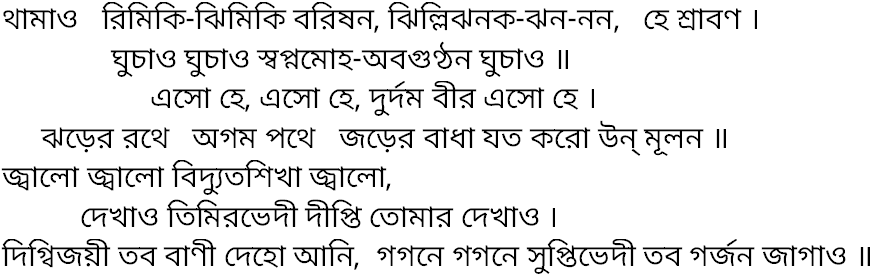
Thaamao rimiki jhimiki borisano jhillijhanoko-jhano-nano, hey shraabano.
Ghuchao ghuchao swapnomoho aboguntthan ghchuao.
Eso hey eso hey, durdom bir eso hey.
Jharer rathe agomo pathe jarer baadha jato karo un mulon.
Jwaalo jwaalo bidyutshikha jwaalo,
Dekhao timirobhedi dipti tomaar dekhao.
Digbijoyi tabo baani deho aani,
Gagone gagone suptibhedi tabo garjano jagao.
More about this song thamao rimiki jhimiki
Get detail information about the song i.e. musical composition, background history, notation, translation and staff notation with downloadable options. Visit the following links.